Indian Stylemaster A Futuristic Scooter
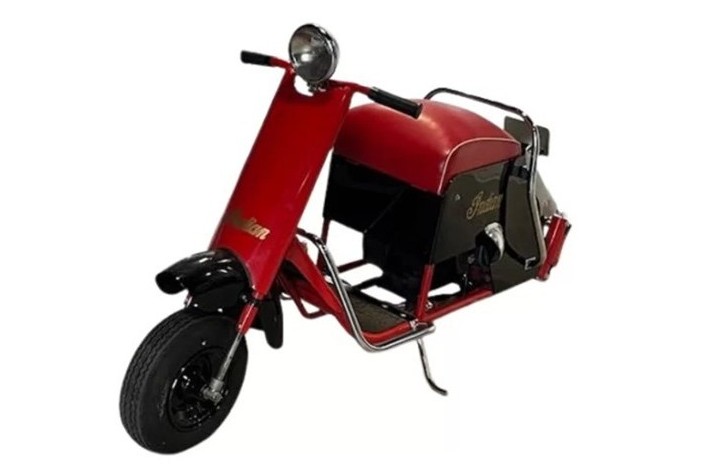
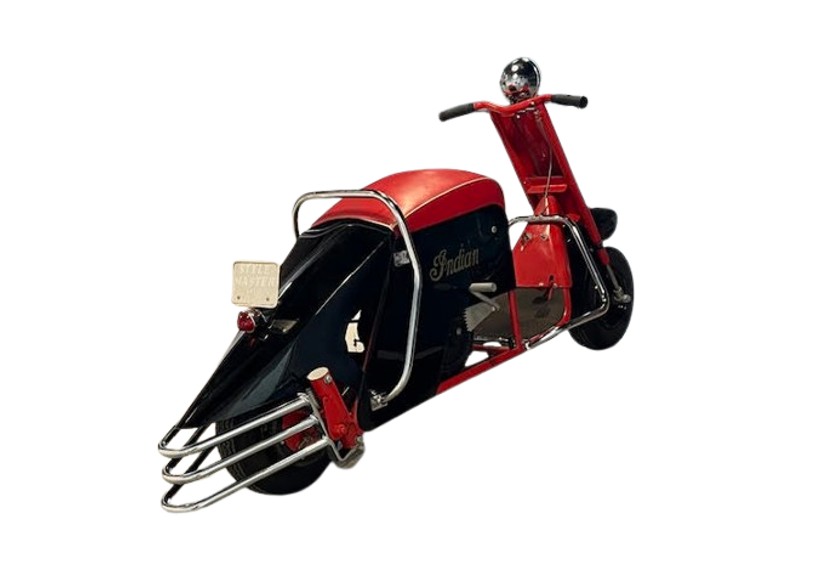
Discover the 1949 Indian Stylemaster: a futuristic scooter born from the collaboration between the Indian Motorcycle Company and Lowther Manufacturing during the post-war mobility revolution.
Indian
USA
1949
The origins of the Indian Motorcycle Company date back to the early 20th century. It was one of the first motorcycle manufacturers in the world and was known for its innovative engineering, including the early use of V-twin engines.
The relationship between the Indian Motorcycle Company and the Lowther Manufacturing Company forms a small but interesting chapter in post-war mobility history. In the late 1940s, Indian was struggling with financial difficulties and a changing market, where heavy motorcycles were losing ground to lighter forms of transport like scooters.
The Lowther Manufacturing Company, based in Joliet, was one of the smaller players capitalising on this trend. The company developed quirky scooters that deviated from the European norm. Instead of compact and minimalist designs, Lowther opted for a more experimental approach, emphasising comfort, protection and ease of use. Their vehicles used Briggs & Stratton engines and often featured distinctive, car-like bodywork and unusual technical solutions, such as a single pedal for both throttle and brake. The Lowther Lightnin’ Airflo is a prime example of this.
The relationship between Indian and Lowther illustrates how established brands sometimes relied on smaller, innovative players during times of change. In this context, the Indian Motorcycle Company sought ways to quickly enter the scooter market. Instead of developing an entirely new model, the company appears to have utilised existing Lowther designs. These were adapted and marketed under the Indian name, with the Stylemaster being the best-known example.
The design of the Stylemaster clearly reflects this origin. In contrast to the sleek lines of European scooters, the Stylemaster had a more robust and almost car-like appearance. Additionally, the model possessed a certain futuristic quality for its time. Due to its enclosed forms and unusual proportions, it appears more like an experiment in personal mobility than a fully developed mass-produced product.
Although these design choices were progressive, they did not fully align with the expectations of the American market. Demand for scooters remained limited, and neither Lowther nor Indian Motorcycle Company were able to build lasting success in this segment. The collaboration was therefore short-lived, and both names soon disappeared from the scooter landscape.
Yet the Stylemaster remains an interesting example of how innovation and collaboration come together in a transitional period. The model shows how a traditional engine manufacturer experimented with new forms of mobility, made possible in part by the ideas of a small, creative manufacturer like Lowther.